How long the repair will take is the first thing almost everyone asks a body shop, and it is a fair question. You need to get to work, pick up the kids and plan around a missing car. The honest answer is that it depends, but it depends on a handful of things you can understand and, in some cases, speed up. This guide walks through where the time goes in a typical collision repair and what Oahu drivers can do to keep things moving.
The short answer
A light scuff on a bumper cover and a hard hit to the front corner of a car are completely different jobs. The first may involve one panel, some paint and relatively little shop time. The second may involve the bumper, headlamp, fender, inner structure, suspension parts and wiring, several rounds of paint, and a wait for parts.
Across the United States, repairs take noticeably longer than they used to. CCC Intelligent Solutions, whose estimating software many insurers and shops use, reported in its third-quarter 2025 Crash Course that overall repair days were down about two days from their peak but still up by four to five days compared with 2020[1]. It pointed to supplement handling and technician shortages as factors that could be stretching repair times[1]. Those are national figures, not a promise about any single car, but they explain why a repair can take longer than you might expect.
Where the time goes
A collision repair is a chain of steps. Each one has to finish before the next can start, so a delay anywhere pushes everything back.
Getting the car in
The clock starts before anyone touches the car. Shops schedule work, and a busy shop may not be able to start your repair the same week. A 2026 CCC article, drawing on its Crash Course 2026 report, puts scheduling backlogs at roughly 1.8 weeks, down from about 5.8 weeks in early 2023[3]. If your car can still be driven safely, you may be able to keep using it until the repair slot opens. If it cannot, it will sit at the shop either way, so getting it there early still helps.
Teardown and the real repair plan
The first estimate is written from what can be seen. The damage that takes time, such as crushed absorbers, bent brackets and broken mounts, is usually behind the bumper cover or inside the door. A teardown, where the damaged parts come off before the repair plan is final, is how a shop finds it.
That step costs a little time at the start and saves more later. California's Bureau of Automotive Repair says documented teardown estimates bring a significant reduction in supplemental estimate revisions, resulting in faster repair times, and give consumers a more realistic timeframe for the repair[4]. California also requires the written teardown estimate to state the maximum time it will take to reassemble the vehicle or component[4]. That is a California rule, but asking your shop how long reassembly would take if you stopped after teardown is a reasonable question anywhere.
Insurer review and supplements
If an insurer is paying, it reviews the estimate, and later any supplement, before that part of the work goes ahead. A supplement is a revision when more damage turns up. CCC points to an increased propensity for repairs to include supplements[2], and supplements add review and approval time while the car sits partly apart. You do not control the adjuster's schedule, but you can make sure the shop and insurer have your claim number, your contact details and your go-ahead without delay. Our insurance repair page explains how we work with insurance companies.
Parts
Parts are often the biggest variable. Common panels for popular models may be easy to get. A specific headlamp, a sensor, a trim piece for an older or imported car, or anything on national back order can take much longer. CCC's late-2025 report described persistent bottlenecks in key electronic components that delayed otherwise straightforward repairs, giving the example of a simple bumper repair waiting on a back-ordered sensor[2].
On Oahu there is an extra step: a part that is not already on the island has to be shipped here. That is one reason a good shop orders everything it can as soon as the repair plan is approved, rather than one part at a time. If a key part is on back order, ask whether the car can be put back together and returned to you while you wait, and whether that is safe.
Body and structural work
Panel repair, replacement and any structural work come next. If the frame or unibody was hit, the structure has to be measured and brought back to specification before panels are fitted, because everything else lines up off it. That work cannot be skipped to save time. If you are curious what it involves, see our frame pulling page.
Paint and cure time
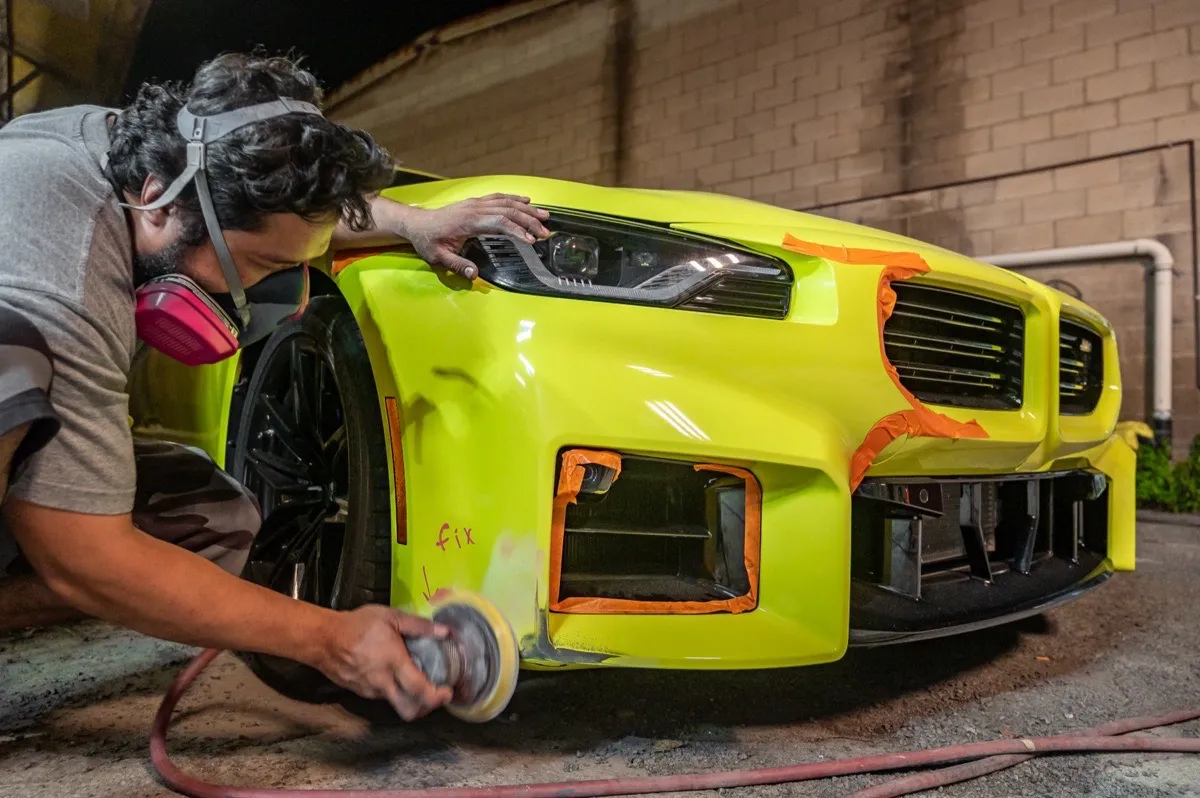
Paint is where people are most tempted to ask for a shortcut, and where a shortcut shows. Each repaired panel is prepared, primed, painted with the base color and then clear coated, and the color is usually blended into the panels next to it so the repair does not stand out.
The finish then has to dry or cure. I-CAR explains that paint makers publish temperature and time ranges in their technical data sheets, that drying times can increase with insufficient airflow, and that some products are not meant to be force dried at all[5]. It also notes that a vehicle maker may set a temperature and time not to exceed when baking refinish products, which can mean different paint shop scheduling or a different clear coat for that car[5]. In plain terms, the paint schedule follows the products and the car, not the calendar.
Reassembly and final checks
Once the paint has cured, the car goes back together: lights, trim, bumper, moldings and any parts that came off for access. Panel gaps, doors, lights and warning lamps are checked, and the car is cleaned. A good final inspection catches small problems while the car is still in the shop, not a week after you pick it up.
Things that make a repair take longer
- Hidden damage found during teardown, which needs a supplement and possibly more parts
- Back-ordered or shipped-in parts, especially electronic parts and parts for less common models
- Waiting for approvals, from the insurer or from you
- Structural damage, which adds measuring and straightening before any panel work
- Paint on many panels, including blending into neighbors
- A total loss decision: CCC's late-2025 report showed total loss frequency edging up from 22.1% to 22.8%[2], and if an insurer decides the car is not worth repairing, the timeline becomes about settlement, not repair
What you can do to speed things up
- Report the claim right away and write down your claim number and adjuster's name.
- Send clear photos of the damage and the whole car to the shop early, so it can start planning.
- Get the car to the shop promptly, especially if it is not safe to drive.
- Answer calls and approve decisions quickly. A supplement waiting on a reply is time the car sits still.
- Ask about parts on day one. Which parts are needed, which are on the island, and which are coming from elsewhere?
- Ask about a rental early. Some policies include rental coverage with limits; some do not. Fly Garage has rental options to ask about while your car is in for repair.
Questions to ask about your timeline
- Will you do a teardown before the repair plan is final?
- Are any of my parts on back order or coming from off-island?
- What is the next step, and what is it waiting on?
- Will you let me know if the date changes, and why?
- Is it safe to drive the car while I wait for parts or a repair slot?
Getting started with Fly Garage
Fly Garage does collision repair and paint on Kaliawa Street in Honolulu. We work with all insurance companies, write estimates in CCC ONE, and straighten frames in-house on Chief EZ Liner equipment with tram-stick measuring. Send us photos and whatever claim details you have to get started. Call the body shop at 808-285-3272, or for a car that cannot be driven, call our towing line at 808-341-6511.